AI has now gone beyond being a tool that makes development easier,
and has entered a stage where workforce reduction is being realistically discussed.
In my experience, doing more work faster has certainly become possible.
From code generation and test supplementation to refactoring suggestions,
AI significantly boosts developer productivity.
However,
if you ask whether a non-developer can perfectly perform development tasks using only vibe coding,
my answer is clear.
“It is still very difficult.”
The problem isn't simply about grammar or technical proficiency.
The task of repeatedly making partial modifications without understanding the code
is far more dangerous than one might think.
Especially when working in a team of two or more,
AI might become a tool that rapidly accumulates technical debt rather than increasing productivity.
AI generates plausible code by referencing context,
but it does not take responsibility for whether that code:
There is an actual case.
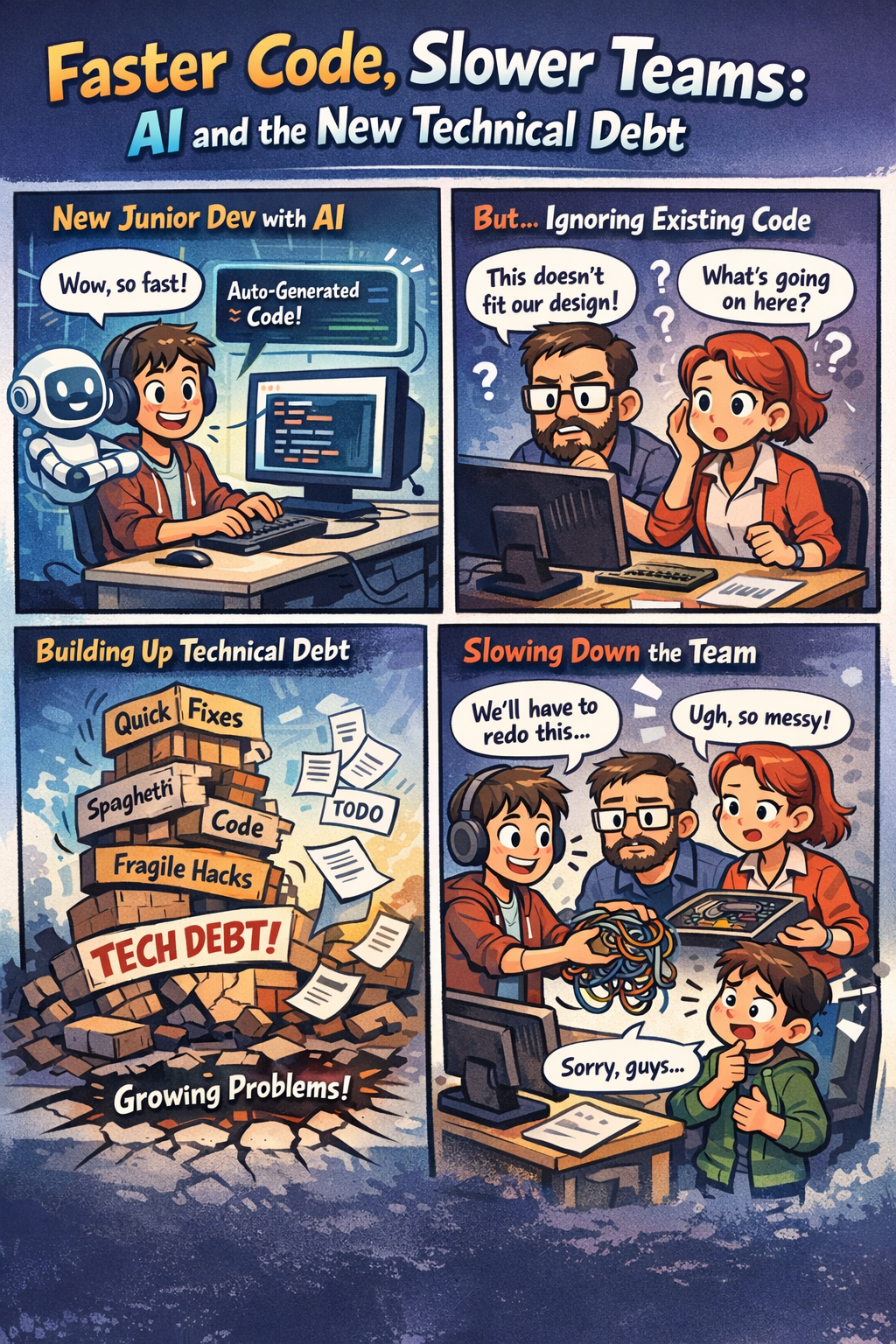
Our team once hired a junior developer to work on a project.
Lacking project and team experience, the developer
focused on implementing immediate features
rather than fully understanding the existing source code.
With AI's help, features were built quickly,
but the senior developer had to spend more time
organizing the results to fit the team's code style and structure.
Ultimately, to meet team standards,
the design had to be supplemented, code rewritten,
and the intent documented.
What I felt during this process was clear.
AI gives speed to the individual,
but it can leave behind debt in the form of unaligned code for the team.
In particular, apps built by junior developers alone with AI assistance
might look highly complete initially,
but often, the cost of modification skyrockets
with even small requirement changes.
I realized once again that technical debt arises not from the amount of code,
but from unshared intent and context.
So when a new developer joins the team,
I feel that now, more than tech stack or speed,
have become much more important.
If I were to consider hiring a junior developer again,
I would probably ask this:
Not “How well do you use AI?”
But “How much have you respected others' code while working?”
In an era where AI accelerates development,
in teams where two or more people work together,
human thinking and collaborative ability
become the most powerful mechanisms to reduce technical debt.
Therefore, I
judge future developers
not as people who create a lot of code,
but as people who know how to create together.