
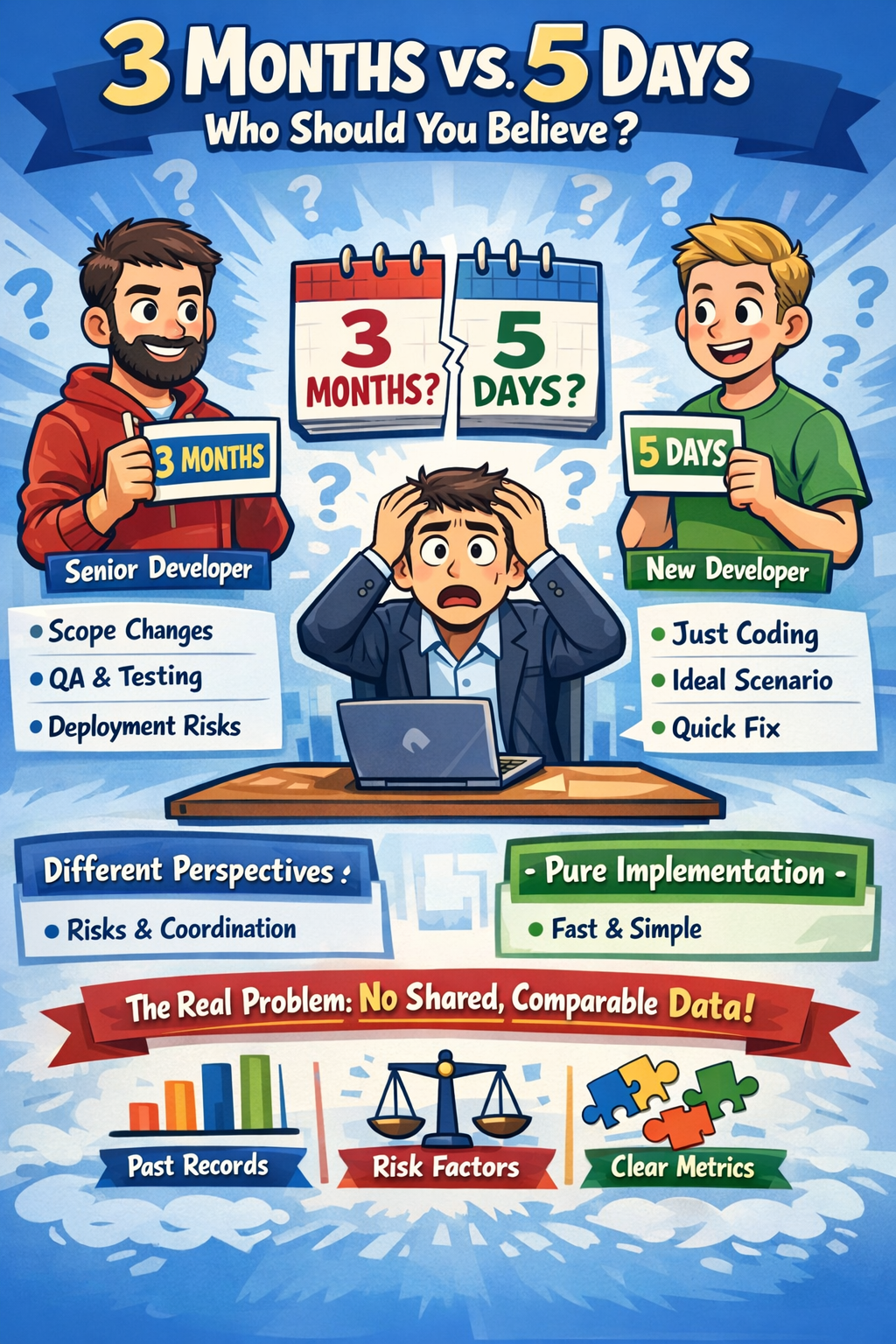
This happened when I was working as a startup CTO.
After designing a feature, I called developer A, who had been with the company for a while, and asked for an estimated completion time.
The answer was "It will take about 3 months."
I was from a development background and had gone through similar projects many times.
Honestly, it didn't make sense.
So, I called a newly joined developer and asked the same question.
The answer was "It will take 5 days."
This moment is
a disaster for managers or executives without project experience.
3 months vs. 5 days.
The difference isn't just a matter of opinion;
it's a number that shakes up business schedules, resource allocation, costs, and investment timelines.
So, who should we trust?
Not necessarily.
Experienced developers often provide
as part of a "realistic timeframe."
The 3 months might not be "coding time" but rather
"time to take responsibility if something goes wrong."
This is also not the case.
The new developer might have been stating
the "pure implementation time."
This is also true.
If it were just about writing code, 5 days might be accurate.
The real issue in this situation
is not who is right.
The problem is the complete lack of visible grounds for these questions.
From a manager's perspective, there's no way to distinguish
between a "slow developer" and an "exaggerating developer."
Ultimately, they resort to gut feelings,
and those gut feelings almost always ruin the project.
To reduce this confusion,
estimating development timelines requires at least the following:
In other words,
instead of "This time it's 3 months" or "This time it's 5 days,"
everyone should be able to understand why that duration is estimated and how it compares to previous projects.
Developers don't lie.
They simply speak from different perspectives.
The problem is
the lack of a common language and metrics to explain these differences,
and the burden always falls on the managers and the entire organization.
It's time
to ask "What can we use as a basis for judgment?"
rather than "Whom should we trust?"