When I worked as a development manager at a startup,
the thing I repeated the most was “making plans”.
Business schedules came first,
development plans were made to fit those schedules,
and from then on, it was a structure of struggling every day to reach the goals.
But at some point, something strange starts to happen.
The team stops building the product and
starts becoming optimized for making excuses to keep the plan.
In the end, the result is similar.
The schedule was met, but a product no one wants comes out.
Plans are necessary.
But plans cannot replace execution.
Problems that occur during execution
cannot all be predicted at the planning stage.
But the bigger problem lies elsewhere.
When you start running solely based on the schedule,
the team's interest shifts from “What should we build” to
**“By when must we finish”**.
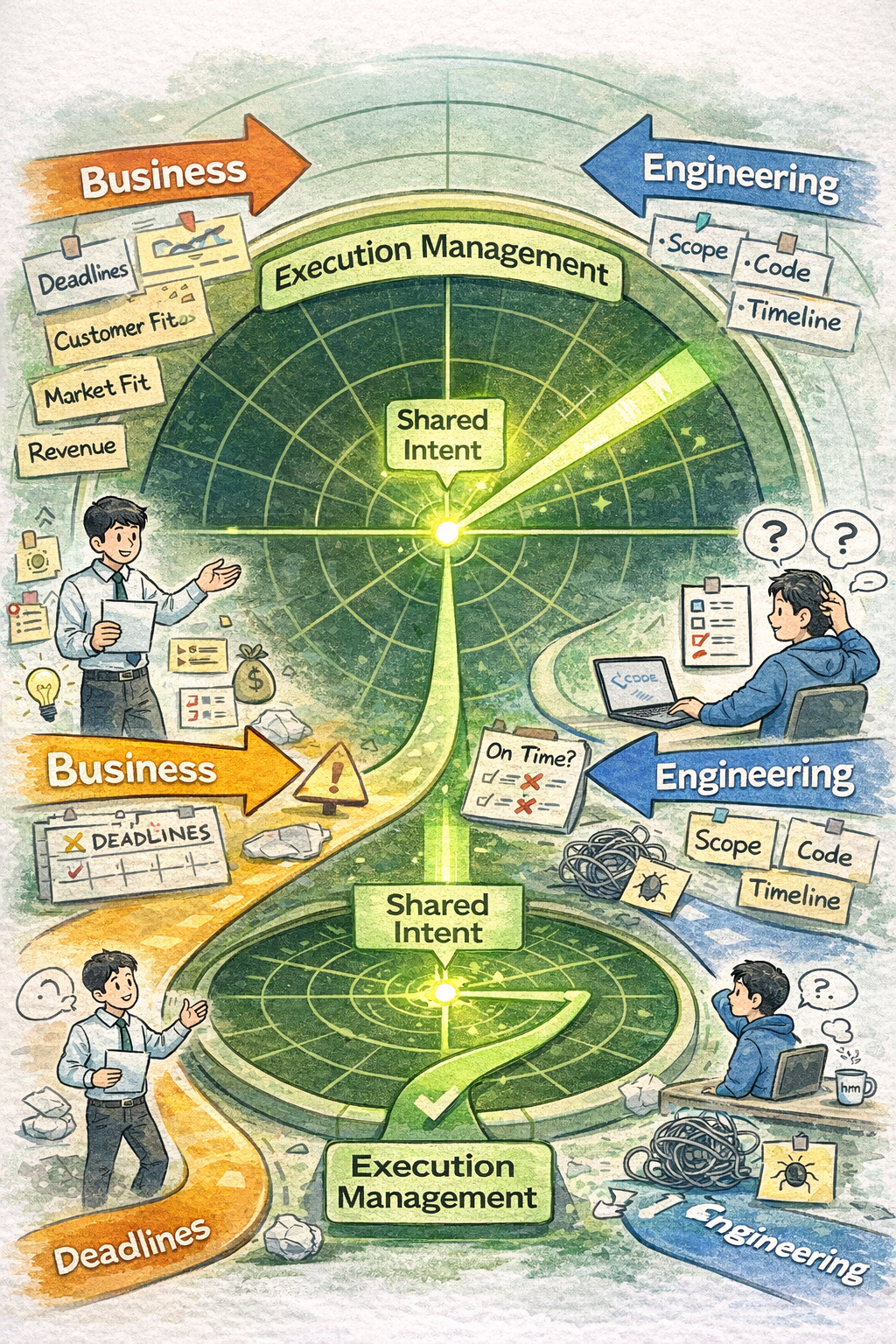
From this moment, the development team and the business team
stop running towards the same goal and
start colliding with different orientations.
Neither side is wrong.
It's just that the standards they look at have changed.
And in teams where only the schedule remains,
misunderstandings eventually pile up.
Actually, both are only partially true, but the core is this.
We only agreed on the schedule,
we never agreed on the intent.
One thing must be made clear here.
It is difficult for the development team
to read the market, analyze customer needs,
and derive the “correct product” on their own.
And the moment you shift that responsibility to the dev team,
they choose one of two things.
Both fail.
What's important in a startup
is not “Let's make the dev team build a product that satisfies the market,”
but for the dev team to understand the business intent and
become a team that turns that intent into the best implementation.
Business takes responsibility for the market,
development takes responsibility for implementation,
but **a structure where the intent is aligned as one** is needed.
Many teams run plans like final versions.
But a plan is a hypothesis.
The moment you operate a plan like a contract,
the team starts making distorted decisions to meet the plan.
✅ Practical Application
Goals in schedule-centric organizations are usually like this.
This is a task list, not a purpose.
Intent-centric goals look like this.
In other words, the goal becomes not the feature,
but implementing the flow the business wants.
✅ Practical Application
Change the sprint goal sentence like this
Here, the success criteria doesn't have to be the market,
but **the business intent criteria (conversion, flow, data, operational feasibility).**
Execution management is ultimately a battle against risk.
The moment you look for risks in a meeting,
risk becomes an argument, and the schedule becomes a defense.
Risks are only seen when you get your hands dirty.
✅ Practical Application: The 48-Hour Rule
If there is a “vaguely difficult” task,
do the work to just verify the risk within 48 hours first.
Doing this becomes grounds for decision-making,
not an “excuse”.
The phrase most used by plan-centric teams:
“We are currently 70% done.”
The reason this phrase is dangerous is that
hell might exist in the remaining 30%.
Execution-centric management looks at it like this.
✅ Practical Application: Daily 10-Minute Checklist
Sharing just these three
drastically reduces misunderstandings between business and dev teams.
If you rush the schedule,
abandon the intent, and just fill in the features, the result is this.
An unwanted product fitted to the schedule
What's more fatal in a startup is
not a product coming out late,
but a product that came out fast but is different from the business intent.
✅ Practical Application: Priorities When the Schedule Collapses
In other words, the schedule is adjustable,
but the intent must not be broken.
If we focus on the plan,
we can become a “team that keeps the schedule”.
But if we focus on execution,
we become a “team that implements business intent”.
And for business and dev teams to move as one team in a startup,
what is ultimately needed is this.
Not the schedule, but
Execution Management Aligned with Intent
If you run only with the schedule,
business and development create constant misunderstandings
while having different goals.
Conversely, if you share the intent,
even if the schedule shakes a little,
the confidence that you are looking at the same goal remains.
That is what keeps the team from collapsing.