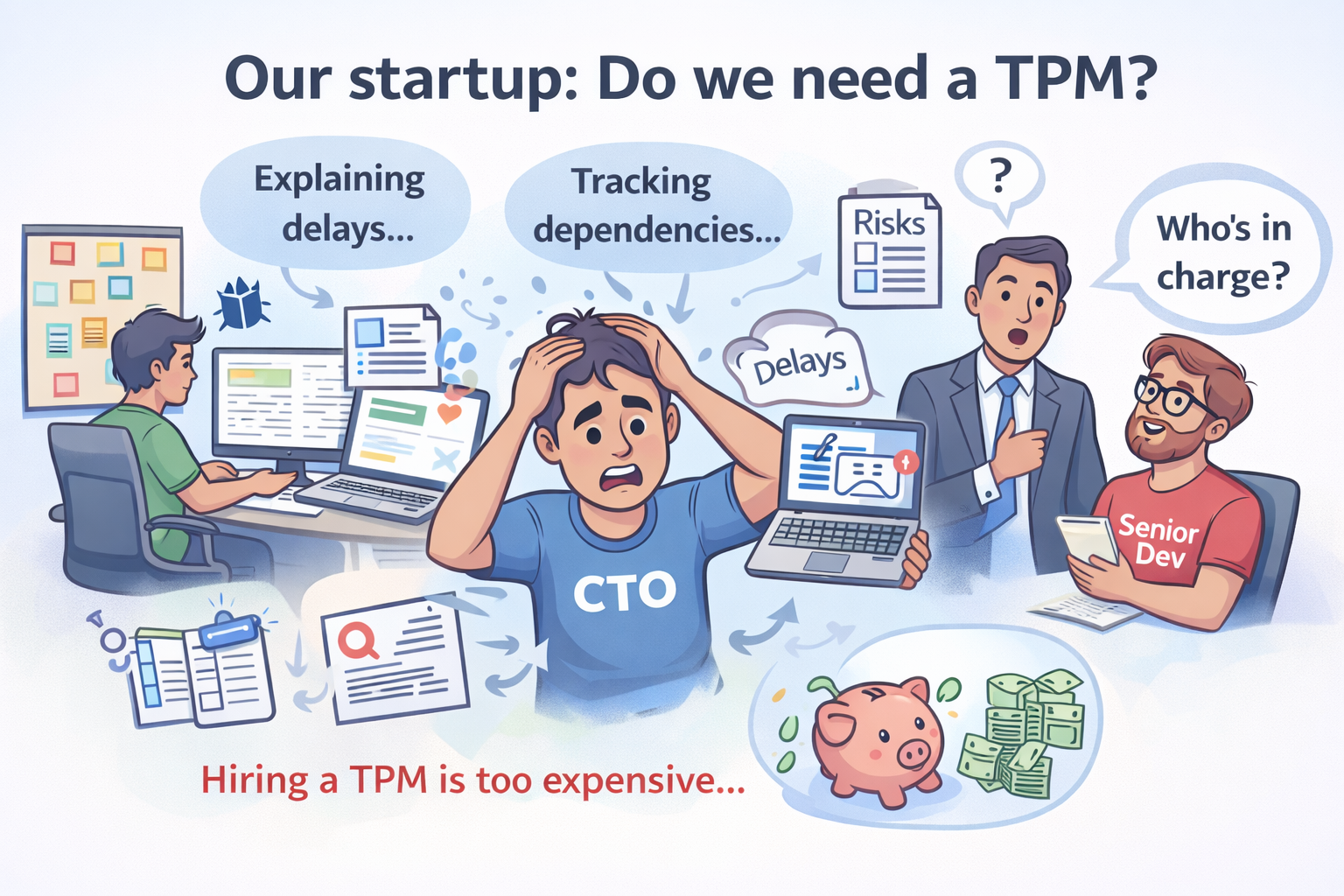
When the topic of TPM (Technical Program Manager) arises in early-stage startups, the same question always follows:
“Do we need a TPM?”
And then, a realistic answer emerges:
“We need one, but it’s difficult right now.”
This article discusses why the TPM role exists and what changes when their responsibilities are broken down and implemented through systems instead of people.
We will also explain where BCTO and Aline.team fit into this process.
A TPM is not just a simple schedule manager.
While a PM focuses on “What should we build?”, a TPM is responsible for the following questions:
As organizations grow and systems become more complex,
these questions naturally converge on one person.
That person is the TPM.
This is also why TPMs are crucial in large corporations.
A TPM is the person who connects technical and organizational complexity.
The challenge lies in the reality of early-stage startups.
Therefore, in most early-stage teams,
the CTO or tech lead takes on the TPM role in addition to development.
The problem is that this structure doesn't last long.
Developers increasingly become coordinators,
and while coordination increases, the basis for decisions becomes unclear.
Here lies a crucial shift in perspective:
Instead of asking, “Should we hire a TPM?”
ask, “What structure can handle the tasks a TPM performs?”
If we divide the TPM's responsibilities, there are broadly two categories:
Do these two areas necessarily require a person to handle them entirely?
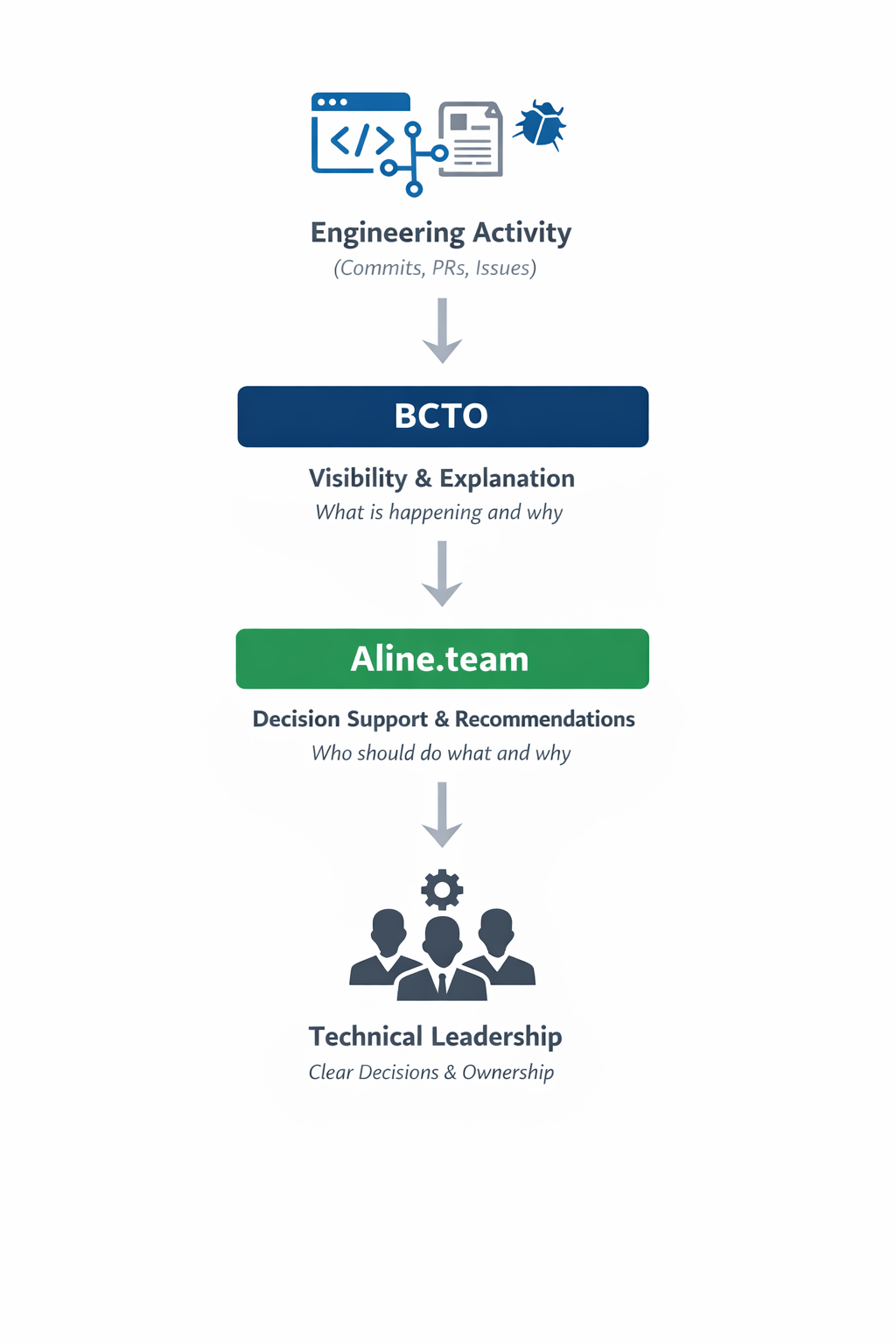
BCTO automates the observation and reporting that TPMs do daily, using data.
The important point in this process is that
it is about explanation, not evaluation.
It doesn't show who did well or poorly,
but rather what structures and flows led to certain outcomes.
While a TPM would provide explanations through meetings and documents,
BCTO offers continuously updated data.
Aline.team goes a step further.
The questions that TPMs often found most challenging are typically:
Aline.team learns individual developers' development patterns and strengths,
analyzes task types and team situations together,
and aims to answer questions like:
This is less about making decisions for you
and more about supporting decisions to make them explainable.
To be precise, no.
These two products are not tools designed to eliminate the TPM role.
Instead, they enable the following:
It creates a structure where systems handle 70-80% of the tasks a human TPM would perform,
allowing people to concentrate on the remaining 20-30% of true judgment and responsibility.
TPM is a role,
and BCTO and Aline.team turn that role into a scalable system.
What early-stage teams need is not
perfect consensus or more coordination.
When that structure is maintained,
experience becomes a strength, and the team accelerates.