It has become so natural to start development with AI these days.
When you explain a feature in words, a screen appears,
APIs are attached, and a service form is created.
The speed is truly overwhelming.
However, there's something I often think about while watching this.
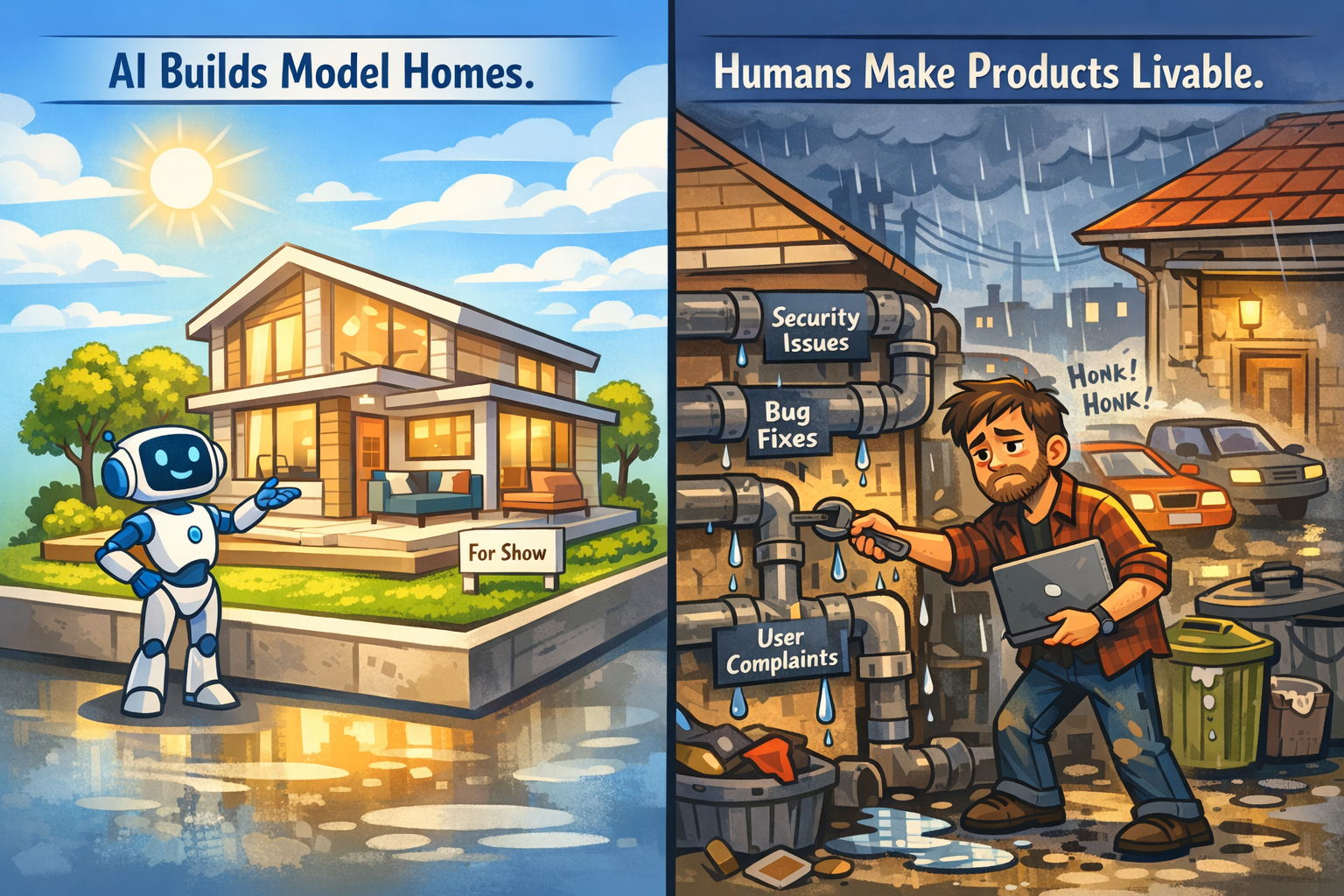
Many of the results we are creating with AI right now
are like model homes.
When you visit a model home, everything looks perfect.
The lighting seems good,
the layout is well-designed,
and the furniture is beautifully arranged.
You can even walk through it
and check the view from the window,
and even the scent is curated.
But there are things you can never know in a model home.
And one more, the most important thing.
Is this house actually safe.
Are the pipes connected properly,
can the electrical design handle actual usage,
are there preparations for fire or flood situations.
All of this is revealed only after living in it and operating it.
AI is currently:
The appearance is plausible.
The space is also well-divided.
If we use an analogy to architecture,
AI can erect walls, install windows, and create the internal structure if it has the blueprints.
It's truly excellent, up to the level of a model house.
However, AI does not make decisions.
Where that building will be placed,
what the surrounding environment is like,
how people will actually live,
and above all, how to prevent risks.
AI creates code.
It creates CRUD, adds login, and configures screens.
But AI doesn't know.
Why this feature was created
Why the structure changed due to a certain obstacle
Where customers kept getting stuck
What repeatedly failed during operation
Where security incidents could occur
These are all histories experienced by humans.
Products change shape and are refined based on these experiences.
At first glance, it's perfect.
However, its limitations quickly become apparent when it enters actual operation.
It's like a house with a building,
but no plumbing or electricity connected,
and the doors don't lock.
It's like having a model home,
but the actual residence hasn't been built yet.
AI can build buildings.
It can also create model homes.
But placing that building within actual life,
and continuously adjusting it to fit the situation and environment
is human judgment and experience.
AI creates the structure.
Humans create context and responsibility.
AI creates a space that can be shown.
People turn that space into a place where they can live safely.
I believe the role of developers will not diminish in the future.
Rather, it will change.
Now, developers will face the question of
not "who can write code faster," but
"who better understands reality and risks."
Those who have experienced the field,
gone through operations,
and directly confronted user inconveniences and potential accidents
will complete the product.
AI builds buildings quickly.
And it creates model homes that look very impressive.
However, it is people who make those buildings truly come alive.
Code can be generated,
but environments and risks cannot.
Ultimately, the product is completed
based on the decisions of humans who have experienced the field.