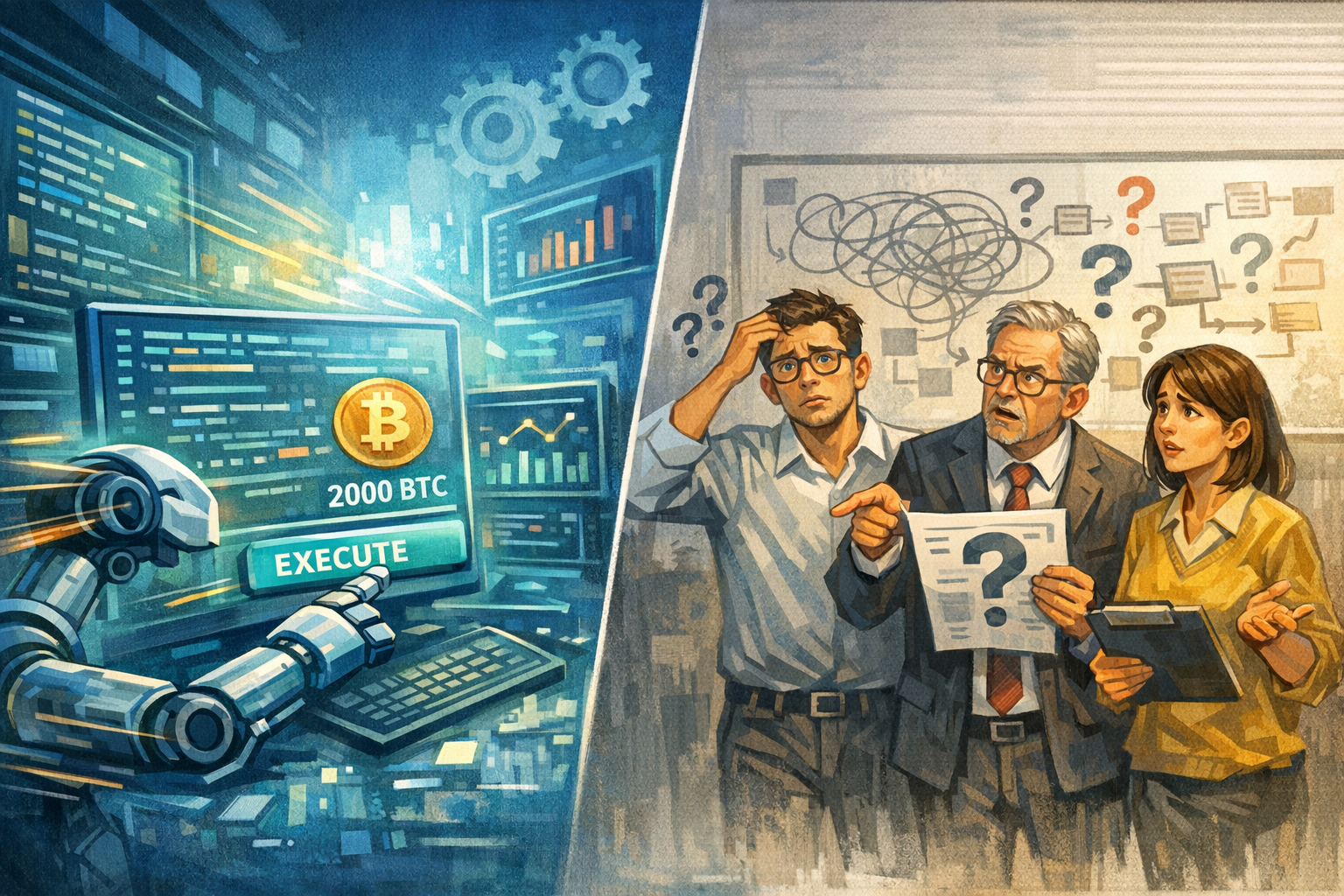
Last week, an unusual incident occurred at a cryptocurrency exchange.
In a situation where 2,000 KRW was supposed to be paid out as part of an event, 2,000 Bitcoin was mistakenly paid out.
There could be several possibilities for the cause of this incident.
It could be a problem in the implementation process, a mistake in the operational phase, or a simple omission in verification.
The important point is that this article does not aim to confirm or definitively state the cause.
However, one question naturally arose while observing this incident.
If this payout logic was code automatically generated by AI, not by a human,
how would we explain the responsibility for this incident?
This is not a story intended to assume facts.
Looking at the current development environment, it's a question that is quite close to reality.
Although the difference between 2,000 KRW and 2,000 Bitcoin seems extreme,
technically, such incidents occur under surprisingly simple conditions.
Unit verification might have been omitted,
there might have been no upper limit check,
or event-specific logic might have been mixed with operational code.
These types of problems have occurred repeatedly even without AI.
They can easily happen in human-written code and during operational processes.
In other words, this incident is not an “accident caused by AI,”
but rather a type of accident that can happen to anyone as systems become more complex.
Let's think one step further from here.
What if an AI agent drafted this logic,
If a person had quickly reviewed it and decided, "This is good enough," and then deployed it,
the landscape after the incident would be slightly different from what it is now.
Who is the entity that created this logic?
Who is responsible for not verifying the units or scope?
Does the person who pressed the approval button bear all the responsibility?
These questions are not easily resolved.
Because while the outcome is clear,
the decision-making process leading to that outcome becomes blurred.
This is the point of discomfort often felt in AI-based automation environments.
The execution clearly happened,
the code remains,
and the logs exist.
But why this unit was chosen,
up to what point it was deemed safe,
and what assumptions were made to allow this logic are difficult to explain.
So, when an incident occurs, organizations often say:
"The system operated that way."
This is less about evading responsibility
and more a statement stemming from a structure that did not preserve the flow of decisions from the outset.
To reiterate,
there is no need to blame AI for this cryptocurrency exchange incident.
However, one thing is clear.
If such incidents occur even in environments where AI is not involved,
then in environments where AI makes more and more decisions on our behalf,
the possibility of these incidents occurring faster and on a larger scale also increases.
Automation can reduce errors,
but it can also amplify the impact when errors occur.
Especially in areas involving money, authority, and operational logic,
a very small judgment can immediately lead to risks for the entire organization.
These questions are likely to arise more frequently in the future.
Was this decision made by a human, or by a system?
How are responsibilities delineated?
Teams that cannot answer these questions
may become more anxious as they introduce automation.
Conversely, there will be teams that become stronger as automation increases.
Teams that can explain the judgments made, even if the results were produced by AI.
Teams where the boundaries between human and system judgment are structurally organized.
Teams that can distinguish responsibilities and areas for improvement when an incident occurs.
The difference between 2,000 won and 2,000 bitcoin
is not simply a matter of numerical error.
This incident poses these questions to us.
In an automated execution environment,
what are we leaving behind?
In an era where AI can create code,
the role of humans is gradually changing.
Not as someone who implements directly,
but as **someone who can document how decisions were made**.
Regardless of the cause of this incident,
it is closer to a scene that foreshadows
the possibility of incidents that must be prepared for in the AI era.