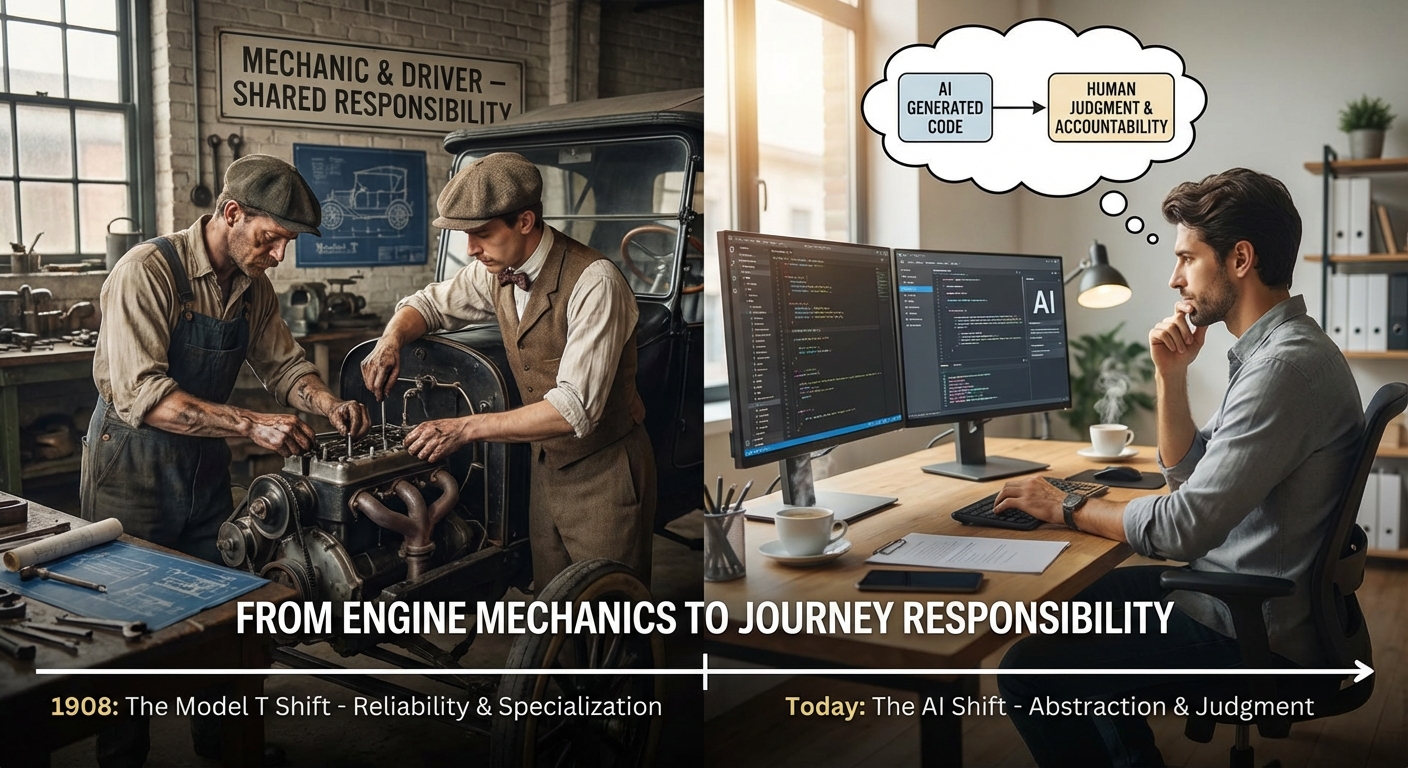
Let's recall the time when cars first appeared.
Back then, cars were not just a means of transportation as they are today. They were not easy to handle and broke down frequently. Understanding the mechanics to start the engine, control the fuel, and fix problems was necessary. It was an era when the roles of drivers and mechanics were much closer than they are now.
Of course, not all drivers had a perfect understanding of the engine. However, cars were clearly closer to technology and not tools that the public could easily access.
In 1908, the situation changed significantly when Henry Ford introduced the Model T and implemented the moving assembly line. Cars were standardized, and production was systematized. Users could drive without knowing the intricate details of the engine, and a structure was established where specialized mechanics handled repairs.
A significant change occurred in this process.
The roles of drivers and engineers began to separate.
Technology became more complex, but the user experience became simpler.
What mattered now was not "how the engine works" but "where to go."
Seeing software development through AI these days reminds me of this scene.
Once, creating software required a deep understanding of languages and structures. Now, AI creates the basic structure, connects functionalities, and quickly implements the form. The barrier to technology is clearly lowering.
However, there is one important point here.
Even if AI generates code,
the responsibility for judging the accuracy, security, scalability, and appropriateness of that code still remains with humans.
Just because cars have become widespread doesn't mean drivers don't need to worry about brake safety at all. Similarly, even if AI writes code, the responsibility for the results does not disappear.
Rather, the role of the developer seems to be shifting one step forward.
From someone who implements everything directly,
to someone who defines problems, designs structures,
and verifies and takes responsibility for the results generated by AI.
This role is not simply "someone who checks code,"
but rather closer to a role that makes technical judgments, manages risks,
and guarantees the direction and quality of the system.
As technology advances, the burden of implementation may decrease,
but the weight of judgment and responsibility may increase.
Perhaps we are standing at another turning point.
An era where not everyone understands the engine,
but it is still up to humans to decide where to go and who will be responsible for that choice.