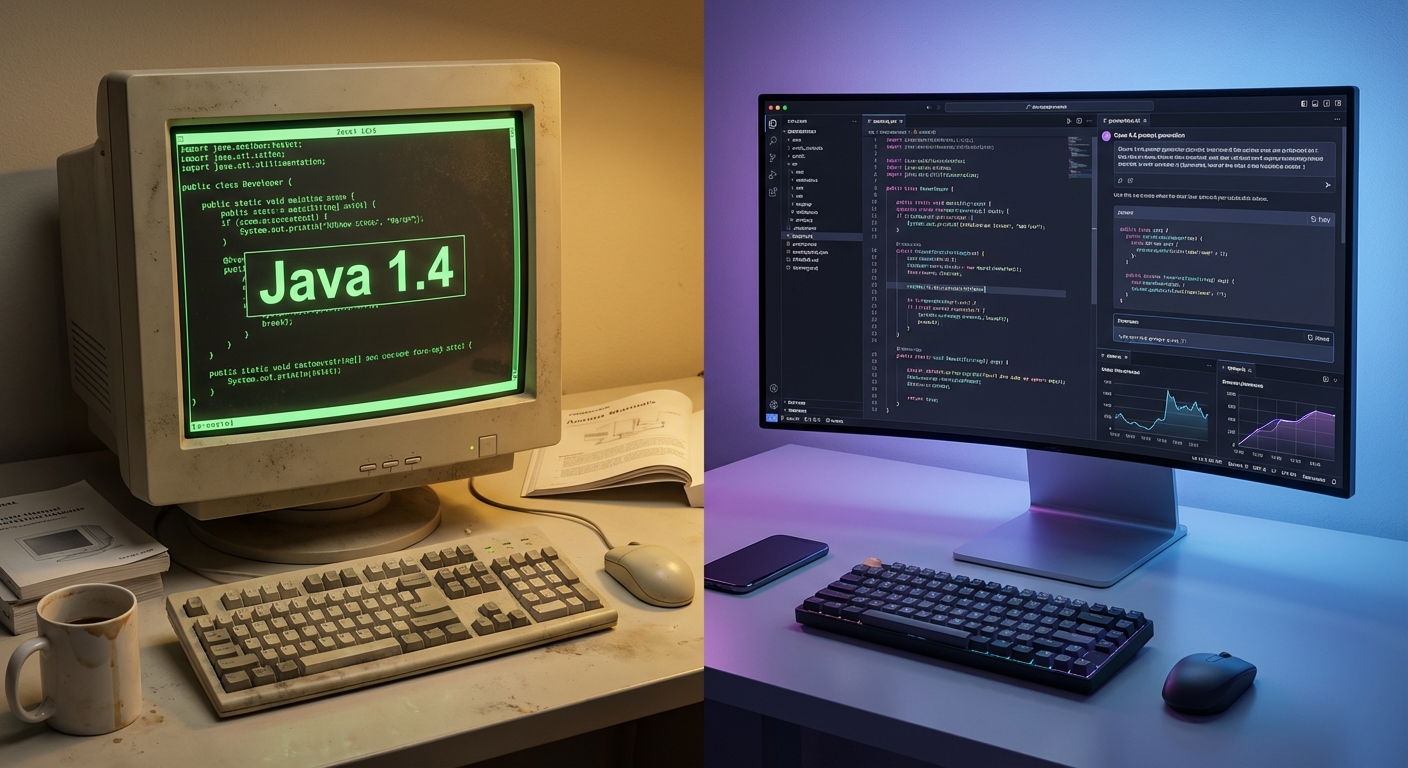
In a cloud project in 2012, a developer said.
“Java 1.4 is still the best.”
Even though the technology was officially unsupported, the remark strangely stuck in my memory. At the time, I thought it was simply a matter of technical preference. But as time passed, I realized that in the developer world, similar statements are repeated every few years, even as technologies change.
At that time, it was a version released in 2002 and officially ended support in 2008. When I heard that, I didn't think it was just a matter of technical preference. Technology keeps changing, but people often fix their standard of technology to the point where they were most familiar with it.
As time goes by, technology changes, but people's attitudes repeat in a remarkably similar way.
I heard a similar story at a recent developer meetup.
“Development is meaningless now. Only those who are good at using tools will survive in the future.”
Hearing that, I recalled that scene from the past.
It seems important now to be good at using certain tools. But tools keep changing. Versions go up, interfaces become easier, and new methods keep emerging.
So, I suddenly had this thought.
Isn't the role called "good at using tools" today also a role that will eventually be replaced amidst another change?
Perhaps in a few years, someone will be saying this:
“Opus 4.6 was the best. I was so good at writing
However, there is one thing we must not miss here.
Deciding what to build, why to build it, and where to go ultimately comes from human experience. Development is not simply about producing code; it is closer to making decisions about what choices to make.
The problem arises when that role becomes increasingly blurred.
When merely using tools starts to be considered the work itself, human judgment and responsibility are pushed aside at some point.
And then, such statements naturally begin to emerge within the organization.
“Why did this turn out this way?”
“I don’t know.”
“Because the AI made it.”
As technology advances, the role of humans should not disappear but become clearer.
Tools will keep changing, and versions will keep updating. But if the role of choosing and taking responsibility based on experience disappears along with them, perhaps only one thing will remain.
The same words repeated every time a problem arises.